Conjunction (Basic ㊦ 335)
In the process or for the purpose of doing something expressed in the の nominalised clause.
Equivalent: In the process of doing ~; (in order) to do ~; for the purpose of ~
| Vinformal nonpast | のに | |
| 話すのに | In order to talk | |
| 食べるのに | In order to eat |
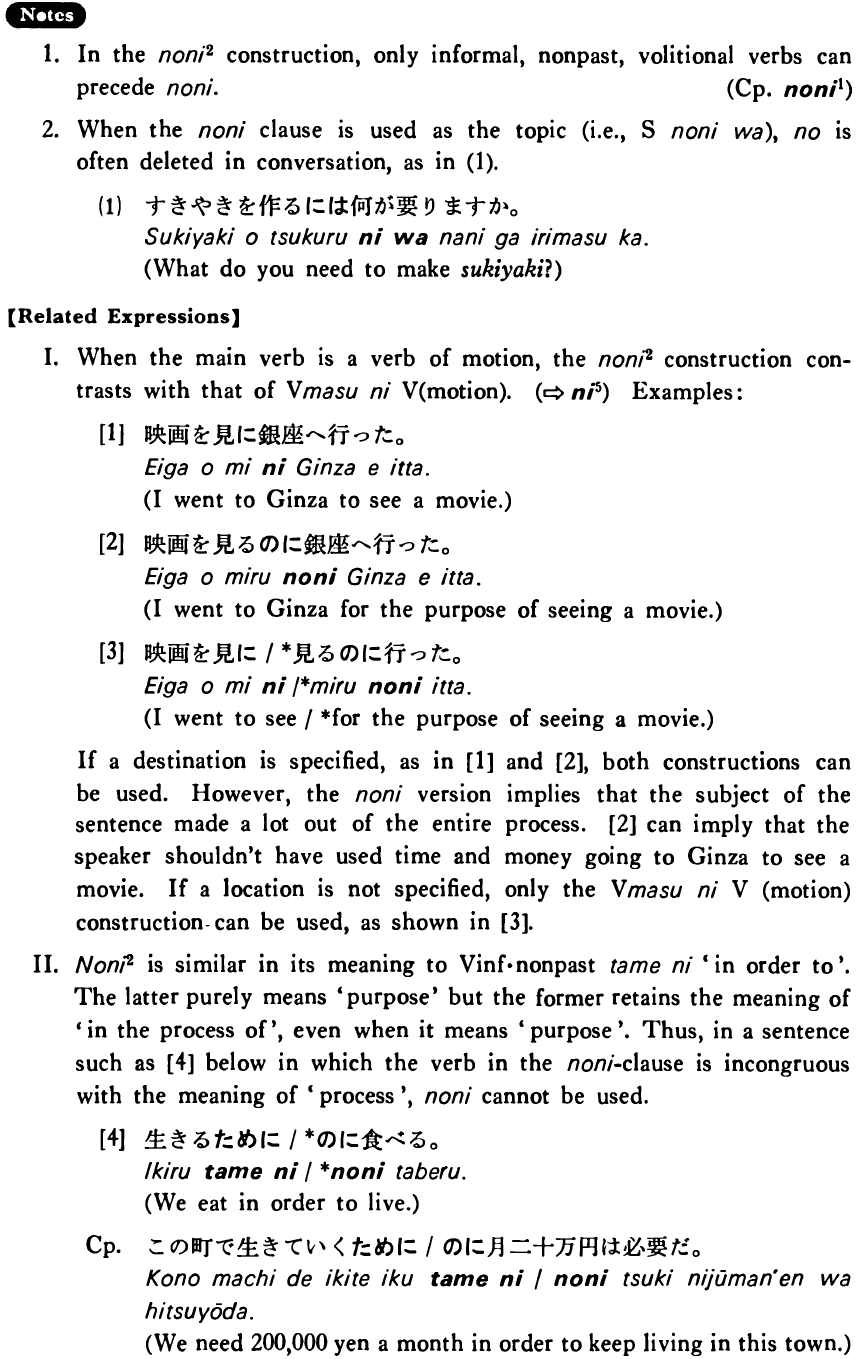
1. In the のに2 construction, only informal, nonpast, volitional verbs can precede のに.
(Complementiser phrase: のに1)
2. When the のに clause is used as the topic (i.e., Sentenceのには), の is often deleted in conversation, as in (1).
【Related Expressions】
I. When the main verb is a verb of motion, the のに2 construction contrasts with that of Verbますに Verb(motion). (⇨ に5) Examples:
[1]
[2]
[3]
If a destination is specified, as in [1] and [2], both constructions can be used. However, the のに version implies that the subject of the sentence made a lot out of the entire process. [2] can imply that the speaker shouldn't have used time and money going to Ginza to see a movie. If a location is not specified, only the Verbますに Verb(motion) construction can be used, as shown in [3].
II. のに2 is similar in its meaning to Verb nonpast為に 'in order to'. The latter purely means 'purpose' but the former retains the meaning of 'in the process of' even when it means 'purpose'. Thus, in a sentence such as [4] below in which the verb in the のに clause is incongruous with the meaning of 'process', のに cannot be used.
[4]